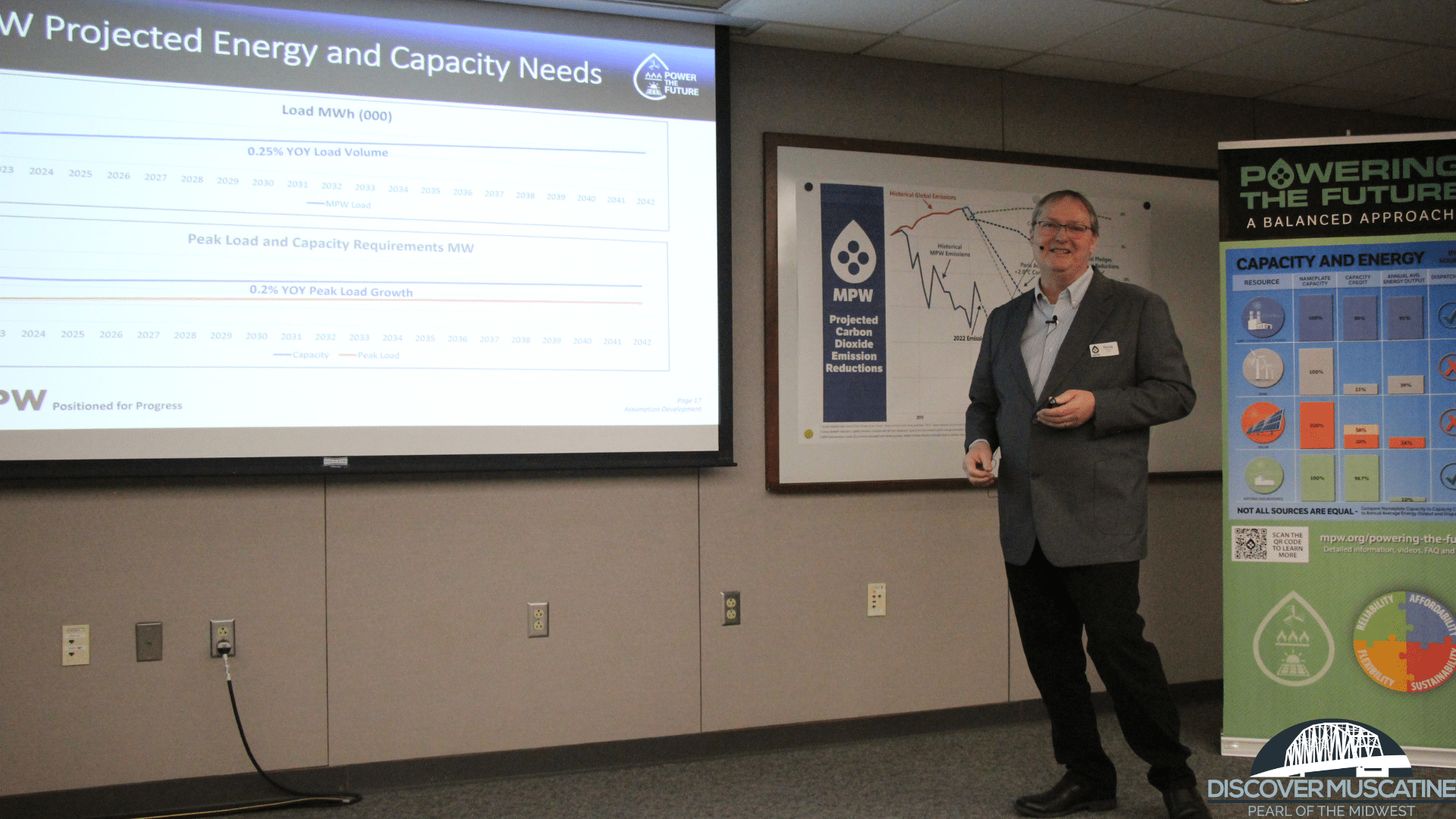
MUSCATINE, Iowa– Almost two years ago, Muscatine Power and Water held their Powering the Future overview showcasing their initial plans for providing local power generation in Muscatine as they phase out Units 7, 8, and 9 while still meeting the goals they set for affordability, flexibility, reliability, and sustainability. As progress continues on the construction of Muscatine Solar 1, Muscatine Power and Water’s initial 24-megawatt solar installation, and the time to fully decommission units 7 and 8 draws nearer, Muscatine Power and Water elected to perform an updated power supply study to understand their current needs and changes in the market. On March 6, Muscatine Power and Water held a customer forum, inviting the public to learn about the findings.
To get the most accurate data and recommendations possible, Muscatine Power and Water engaged Leidos, which conducts power supply studies and modeling throughout the utility industry and beyond. Together, they ran 19 scenarios, each with different combinations of power-producing resources, to see how they would do based on the cost of fuel sources, especially natural gas, the forecast for energy market prices, and if environmental regulations changed.
Through this extensive modeling, Muscatine Power and Water determined that each blend of power-producing resources had benefits and drawbacks. “There isn’t a scenario that is the best,” said Muscatine Power and Water General Manager Gage Huston. “There are tradeoffs.”
Even though no one combination proved perfect, Muscatine Power and Water identified three that had the most promise. The first option kept Unit 9 on coal and built Muscatine Solar 1 at 24 megawatts. With coal prices low, it would allow for reliable and affordable electricity production. The addition of solar and the need to comply with clean air regulations would increase sustainability. However, Unit 9’s inability to run on green hydrogen, a fuel source projected to grow in availability, would make this option less flexible.
Doug White addressed the attendees of Muscatine Power and Water’s customer forum. Photo by Margaret Hurlbert.
Muscatine Power and Water could instead continue to run Unit 9 on coal but build an additional 200 megawatts of solar to supplement Muscatine Solar 1. This would grow their sustainable energy production to about 50% while keeping power reliable and affordable. However, the lack of hydrogen compatibility would still make it less flexible. Muscatine Power and Water could also not sell steam to large industries as they did previously.
Finally, Muscatine Power and Water could build a 50-megawatt combined heat and power natural gas or hydrogen power plant, which could qualify for federal credits under the Inflation Reduction Act, along with keeping Unit 9 on coal and adding 100 megawatts of solar. This most flexible configuration would bring renewable energy generation to about 25%. Concerns over fuel pricing and availability could impact affordability and reliability.
Additionally, Muscatine Power and Water revisited a 100% renewable portfolio. They found it unfeasible at this time, as batteries large enough to carry their whole load during emergency events do not exist yet, and it would cost $887 million upfront to build an adequate battery array and $97 million a year to cover all its related costs. However, they remain interested in exploring more renewable energy options as storage technologies improve. “It’s not saying that we can’t head that way and that our portfolios aren’t going that way,” stated Doug White, director of power production and supply for Muscatine Power and Water.
Before the March 28 board meeting, Muscatine Power and Water will take public comments on their power supply study to help guide future decisions. As Board President Kevin Shields explained, “We will take your comments and thoughts into consideration.”