MUSCATINE, Iowa–During the Second World War in a less well known part of Muscatine’s history, 85 German prisoners of War came to Muscatine from a larger camp in Algona. The prisoners predominantly worked at the Heinz factory, helping make up for a labor shortage caused by many of their usual workers fighting overseas or working directly for the war effort. During the year of 1945, the 85 prisoners lived at the Fairport Fish Hatchery, staying in a laboratory building that had fallen out of use in the previous decade when the facility transitioned from a biological station cultivating mussels to a fish hatchery. Though the prisoners left Muscatine the following year, many retained fond memories of the city, and a few even immigrated to Muscatine to continue working at Heinz until their retirements some 15 to 25 years later.
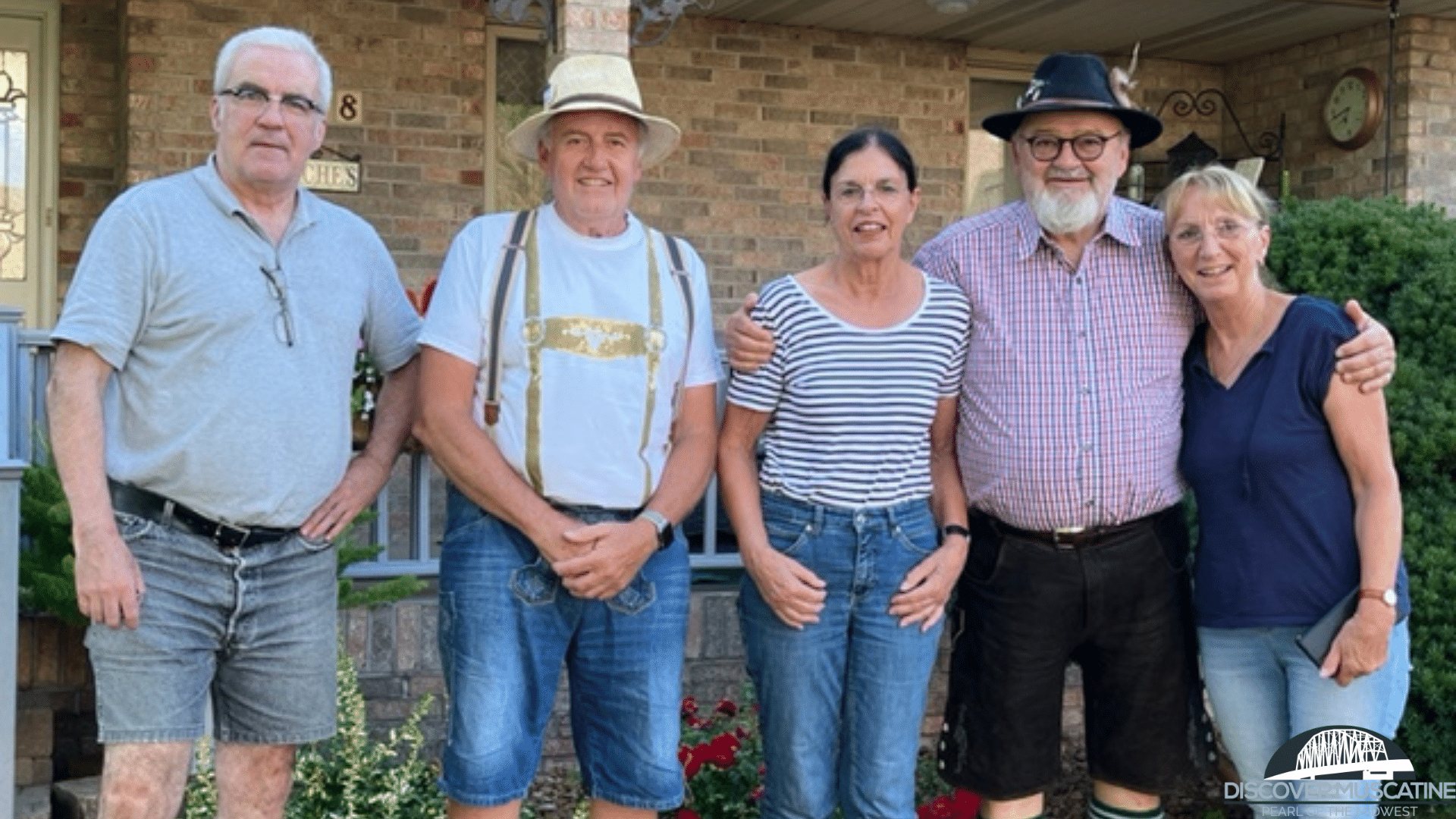
Aug. 3, Herbert Masthoff, the son of one of the German prisoners of war who worked in Muscatine, accompanied by his wife, Gabi Masthoff and her sister, Claudia Henriks, toured the Heinz Factory, the Fairport Fish Hatchery, the National Pearl Button Museum @ History and Industry Center, and the Muscatine Art Center to learn more about Muscatine and to put his father’s experiences into context.
While at the Fairport Fish Hatchery, Friends of the Fairport Fish Hatchery Paul Carroll and Lynn Pruitt accompanied by Melanie Harkness of the Fairport Fish Hatchery showed him around the hatchery to indicate where some of its historic buildings used to stand, including the laboratory where the prisoners of war stayed. Herbert Masthoff recalled that in addition to working at the Heinz factory, his father and the other prisoners of war would often work on maintenance projects around the hatchery as well.
Later in the day, Herbert Masthoff and his family made their way to the National Pearl Button Museum to view artifacts from the time that the prisoners of war lived in Muscatine. This included a carved box created by one of the prisoners who often gave wooden gifts to the other prisoners, including Masthoff’s father.
Masthoff, who though born in New York City where his parents lived for several years after the war, spent most of his life in Germany, took great pleasure in seeing Muscatine and discovering the places his father had such positive feelings for: “”My father truly enjoyed his time at the Fairport Fish Hatchery and in the Muscatine area, despite being a POW. He enjoyed the good meals that were provided and the opportunity to work rather than being incarcerated the entire time. He and the other prisoners were allowed to swim in the reservoir. He enjoyed his time working at the Heinz plant and picking watermelons on the Muscatine Island.”